
An in-depth word vomit on the concept of fate
- What is fate?
- Luck’s part in fate
- Cheating death vs tempting fate
- Sealing one’s fate vs karma
- Freewill, destiny, or both?
- Is intuition tempting fate?
- Fate without fatality
- Are we manifesting our fate?
- The butterfly effect
- Coincidence or fate?
- Take everything said in stride
What is fate?
Soon, a story about fate will be published. While fate itself is interesting to the little philosopher in me, when writing this story, the idea of fate started to become more nuance than I thought.
I remember asking my husband, “How does one tempt fate?” I was expecting a simple transaction of question and answer.
Instead, he said, “It depends on your definition of fate.”
Interesting, isn’t it? Isn’t this proof enough that language is simply subjective, that everyone interprets everything differently? Although, that’s a tangent for another time.
I then asked him, “Well, what’s your definition of fate?”
“Something that happens regardless of what you do. Something that’s inevitable and unavoidable,” He answered. It’s definitely deeper than my definition. Until he made me think about it, I simply thought fate meant everything happened for a reason. While this is part of it, I’d soon find out it wasn’t the whole truth.
On a side note, I don’t know if there is a God (I’m on a journey), but half of my friends do and/or are Christians. I find Christians very much believe in everything happens for a reason and therefore, believe in fate. They are so quick to correct you when you nonchalantly state that something is a coincidence. It made me start to think… During a Bible and Jesus talk one night with my husband, he told me how God has planned everything, and that’s why NASA hasn’t been able to make it to Jupiter yet (long story).
“He doesn’t think we’re ready yet,” he said.
One week at Bible study, one of the girls there said how God gave us free will, that what my husband said wasn’t 100% true. I started getting on board with what my husband was saying, so the girl saying she didn’t agree (even though they’re both Christians) lit a spark of curiosity in me. If fate is something that happens for a reason and will happen regardless of what you do, then can one even tempt fate?
When researching answers to my first question, I found a lot of mixed responses on Quora. Take this one for example:
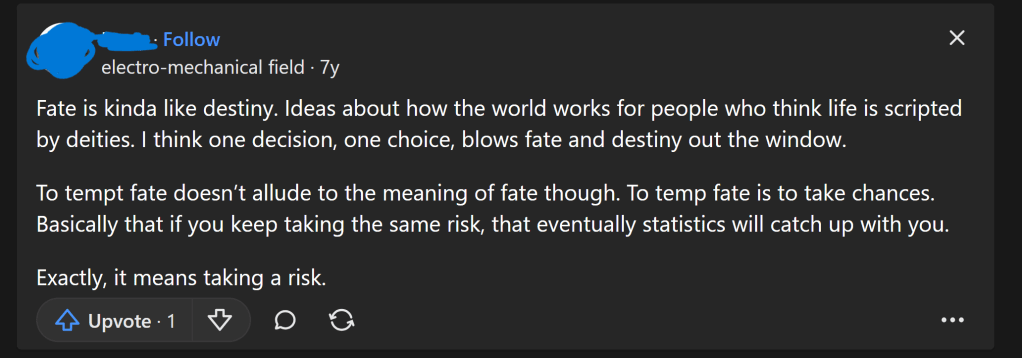
“One decision, one choice, blows fate and destiny out of the window.”
“To temp fate is to take chances.”
If we look at fate through this lens, it appears more like karma than an inevitable event. Through this view, anything can throw off fate. But if something is preconceived to happen, wouldn’t it be fate that it happened?
Luck’s part in fate
A response to the question “What is fate?” is comparing Jack and Rose’s outcomes in the 1997 film Titanic. The person says how Rose, in several circumstance where she should’ve died, was allowed to live. When it came to Jack, the person explains how he won tickets to a poker game that ended in his demise a couple days later.
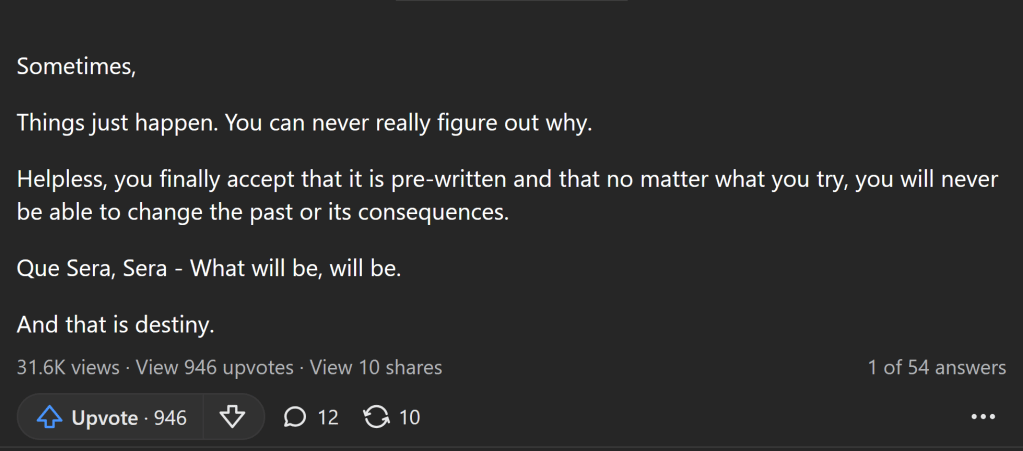
This alludes to the idea of luck, with some people believing in luck and some not. Jack even states in the movie that he “dealt a lucky hand in poker” to win a ticket to the RMS Titanic to be able to be dining with Rose and “you fine people.”
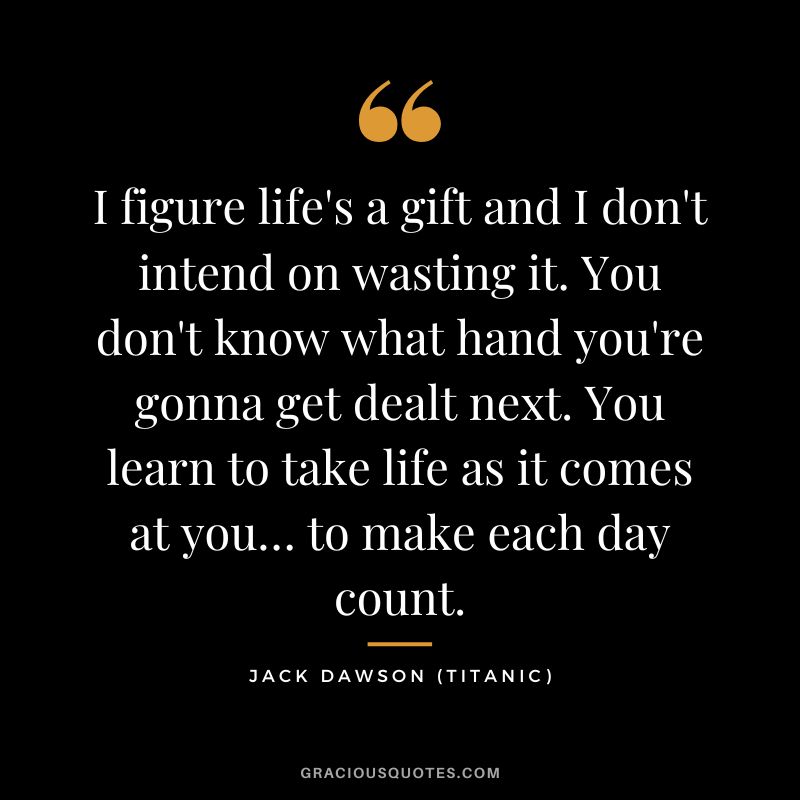
You could see his decision on betting everything and winning those tickets as tempting fate. You could also see it as luck. I see it as regular fate. It was fate that he won that ticket and met Rose. While Jack didn’t end up surviving, meeting him opened many doors for Rose, doors that allowed her to live the life she wanted. You could argue that she could’ve done it without him, but if you don’t know something’s possible, would you try?
On the topic of luck, this person believes it is “the nemesis of all gamblers.” Just read:
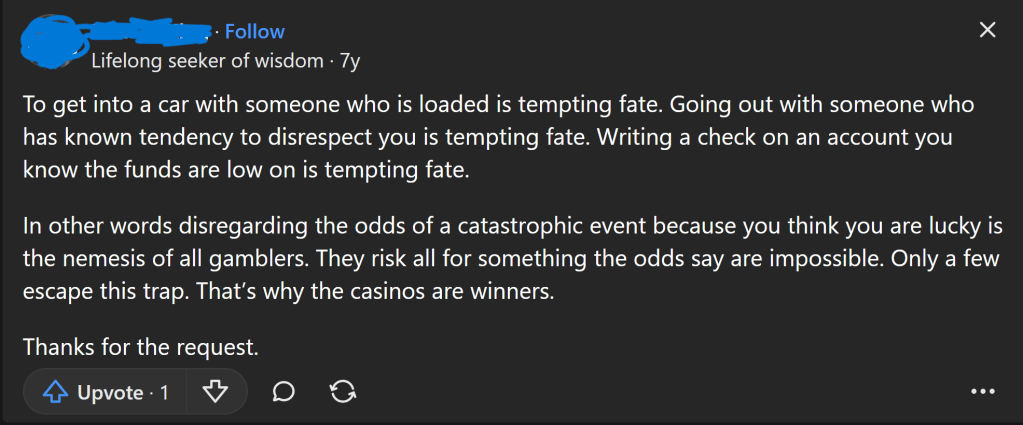
It’s not that this person doesn’t believe in luck, but rather, they believe people shouldn’t rely on luck and think they can escape the inevitable. I can absolutely see where this person is coming from, though.
Everyone thinks they’re invincible at some point in their life. “That would NEVER happen to me,” we all say as we pass by a car crash on the road. “I’m more careful than that person when I drive.” After the shock of the sight, this is what we think (again, at some point in our lives). But anything could happen to anyone at anytime. Jack could’ve lost that poker game that day and would’ve never died. However, something else could’ve killed him. Just like Rose, someone else could’ve saved her that night, and she could still possibly survive the sinking. Fate is funny that way (not funny ha ha, but you know).
Cheating death vs tempting fate
That’s what I believe anyway. But is it fate we’re tempting, at that point, or death? Does fate and death intertwine? Let’s look at another movie: Final Destination. I couldn’t talk about fate and not bring up this movie. For whoever is unfamiliar with this popular and grim (pun intended) franchise, I’ll give you a synopsis:

While this is only the synopsis for the first movie, all of them have the same premise: they cheat death, then one-by-one, they die. These movies are the reason why I will never use a tanning bed, drive behind a truck carrying logs, and am now scared of roller coasters. I’m also scared of cruise ships since watching Titanic, but that’s a story for another time.
In these movies, the characters cheated fate, so fate chased them and plucked them out of the world of the living. The goal of each movie is finding a way to end the cycle of deaths. They eventually do or, at least, think they do. To play the Devil’s advocate, if I saw a vision of me and my friends (or anyone) dying, I would do what I had to to avoid it too. I’m sure everyone would agree. It’s one of those questions we ask our friends at sleep overs: if you knew how and when you were going to die, would you try and avoid it or accept it?
Some people would say they would accept it and make the most of the time they have left; others say they just wouldn’t drive that day or simply put a raincheck on that vacation. But if fate is inevitable, wouldn’t “cheating” it only prolong your death for possible minutes or days more?
Sealing one’s fate vs karma
I mean, many people lump fate and death together, and they wouldn’t necessarily be wrong. The word ‘fate’ is related to the word ‘fatal,’ originating from the Latin word fatum, meaning ‘that which has been spoken.’ In the Oxford Dictionary, one of the definitions is “the development of events beyond a person’s control, regarded as determined by a supernatural power,” including the inescapable death of a person. What’s interesting, however, is the definition of ‘sealing one’s fate:’

This goes back to the conversation of fate being intertwined with karma. We all know what karma is: “the force generated by a person’s actions held in Hinduism and Buddhism to perpetuate transmigration and in its ethical consequences to determine the nature of the person’s next existence,” or more broadly, “such a force considered as affecting the events of one’s life.” The broad definition is what most people go off of. You do something considered bad, then get hit with the consequences, like the example used in ‘sealing someone’s fate.’ You cheat, so then, you deal with the break up or divorce after, possibly losing your current partner and the new over in the process. It’s the same thing.
Freewill, destiny, or both?
So death and karma tangle with fate, but God gave us freewill, right? Then, wouldn’t that mean we control our lives, not this supernatural force of fate? Or could both be true at the same time? Take the anime Future Diary for example.
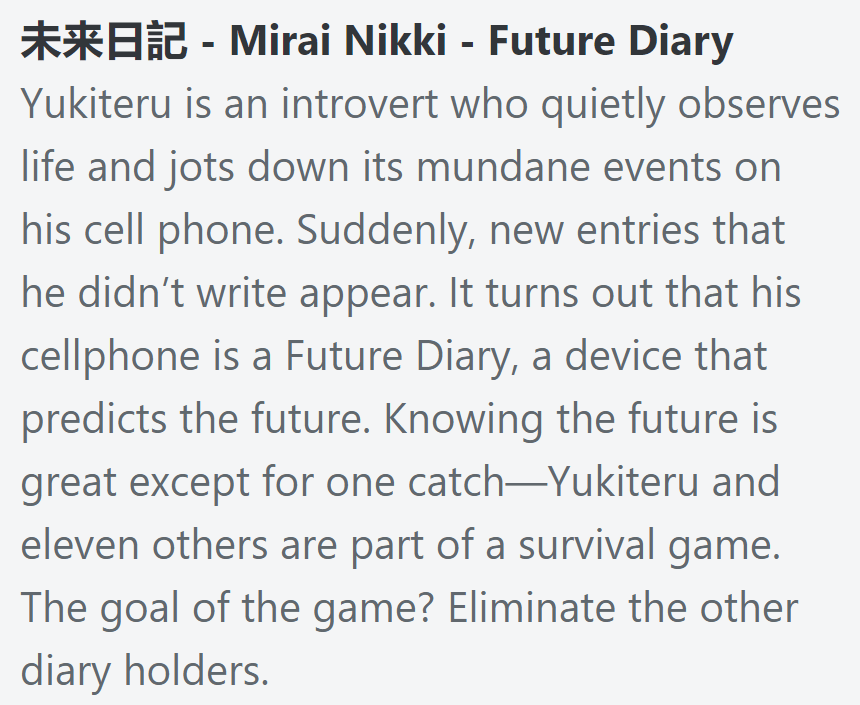
As described above, the diary tells you your future. It tells you where the danger is, so you can go a different way or choose a different option that won’t harm you. It even tells you when you will die, marking it with a ‘dead end.’ This dead end is inevitable — unless you change it. If you continue your current plans or route, you will certainly die, but this gives you an opportunity to change your fate.
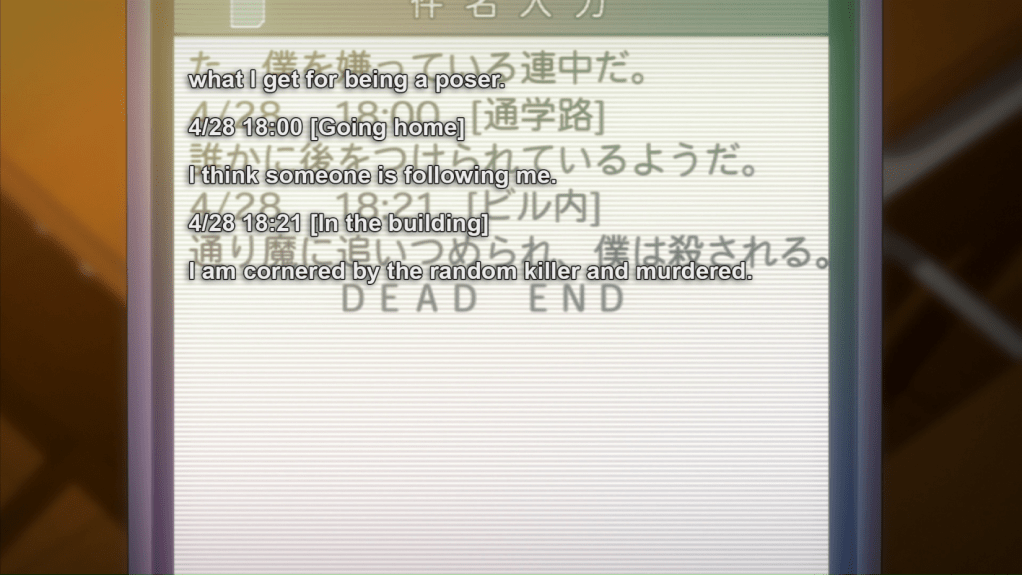
This is interesting because in the movie Final Destination, those who cheated fate would inevitably die. However, in this anime, the players in the game are allowed, or rather encouraged, to do so. Because they are controlling their fate by looking into their future before it happens, nothing is circumstance, only destined and set in stone — until changed once more.
However, because the players know their future and is taking someone’s fate (death) into their own hands, does this mean fate applies to them the same way? If we look at karma and death as subtypes of fate, death would not be excused for these individuals simply because they know what will happen. Just like in Final Destination, they were able to escape death at least for that moment. But for the diary holders, they can still die; they can still make the wrong move. So what about karma? Do they experience karma when they can escape it? Well, in episode 2, a diary holder gets her eye punctured by another diary holder because she was trying to bomb their school, so yes they do.
If we were to look at luck’s involvement here, it would also be embedded in this anime’s concept of fate. When their phones were made as future diaries, it was soon established that every diary told different things. Yuki’s (the main character) diary told him the future of observation — the kicker: his observation only. If he interprets something to be true, it doesn’t necessarily mean it is. Yuno’s (love interest) diary shows Yuki’s actions only. The bomber from episode 2 has a diary that shows escape routes. Together, the three could be powerful, but individually, they’re at a slight disadvantage depending on what they want to know.
So with this information, do we control our lives, does fate, or are both true? Well, it depends.
Is intuition tempting fate?
While knowing what fate is and the subcategories involved with it so far (death, karma, luck), we would need to delve deeper in the concept of tempting fate to honestly answer the question of freewill or destiny.
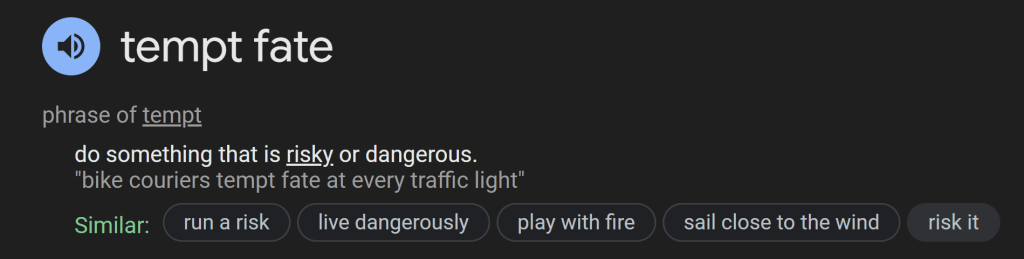
One thing about definitions is it makes things objective, when in reality, words are subjective. That being said, I partly agree with this definition of tempting fate. It definitely correlates with the first example’s notion of one decision, one choice blowing fate and destiny out the window and the third example’s statement that getting in a car with someone with a loaded gun is tempting fate. They both show that taking risks is tempting fate.
But what about Jack in Titanic and Alex in Final Destination? It seems they both tempted fate by unknowingly entering danger (Jack) and willingly escaping death (Alex), yet they both tempted fate by taking a risk. But would this mean intuition is tempting fate too?
Intuition is something that one knows or considers likely from instinctive feeling rather than conscious reasoning. We’ve all experienced intuition at least once. We have a feeling that something is wrong, that something is off, then our actions follow the feeling. There’s a reason “listen to your intuition” is a popular phrase. However, there are many ways to interpret intuition. This is what a bot on Quora had to say:

Although it’s a bot, I like the idea of intuition being more inclusive as a concept than simply being a feeling, so when thinking of intuition, these notions will be considered.
When examining intuition’s involvement with fate, I thought back to Final Destination. Alex had a premonition that the plane was going to crash, not knowing if it was real or not. However, his intuition kicked in and told him something was wrong. If he didn’t listen, him and the seven survivors would’ve died.
Think back to a time where a gut feeling helped you flee from danger. In my husband’s case, this was when he was in a lake and felt something was wrong, so he got out, just to find out later that there was a poisonous snake in it.
Now remember a time your intuition kicked in that something was wrong, but you either refused to listen, thought your intuition was lying, or it was too late to take action. For me, this was the time I accepted going on a date with a man I had a bad feeling about, just for the night be filled with anxiety because I had to sleep over at his place (covid curfew on post).
Would you consider these instances to have altered or tempted fate? It was astonishing that my husband left the water when he did, just like when Alex left the plane before it crashed. In Final Destination, the survivors escaped fate, so death chased them. My husband escaped danger, but it wasn’t definite that he would’ve died if he didn’t exit the water. He may have been bitten or he may have been left alone. We know this through Final Destination logic. If he had cheated fate, death would’ve been chasing him. While I don’t particularly believe this mindset, I do believe he had fate on his side, that it wasn’t his time. So then, does this mean intuition is actually fate speaking to you?
This is one flaw with Final Destination. If tempting fate is putting yourself in harm’s way, then what happens in those movies is simply fate working its magic.
However, intuition isn’t always a bad feeling. I call these ‘pleasant premonitions.’ Pleasant premonitions can come from a sign for you to call an old friend while on your way home or from finding a cat hiding in the sewer near your house. Pleasant premonitions can be when you have a feeling your friend is going to apologize after they say something mean to you. Pleasant premonitions can be knowing you’re pregnant before witnessing any symptoms.
Fate without fatality
Fate isn’t always life or death. For example, in Titanic Molly Brown lends Jack her son’s tux — a perfect fit. It was fate that she even had her son’s tux with her regardless of not having her son with her on the ship. In her case, it must’ve been intuition leading to that decision.
With all the talk about fate having to do with risky situations, after my husband told me his definition of fate, I told him, “I believe us meeting was fate.” He told me he agreed, making the question of nonfatal fate remain.
I then asked him how someone would tempt fate in a relationship with his definition in mind, and he told me, “Someone who goes against common sense, where it’s meant to be. Like, someone who’s hesitant or playing games.”
I asked him to elaborate.
He then said, “Let’s say you met the one, and you know they’re the one. Yet, you’re still hung up on your ex. You would be tempting fate because you’re prolonging getting together with that person.”
Let’s go back to his definition: ‘Something that happens regardless of what you do.’ In his example, someone prolonging dating ‘the one’ is tempting fate, but would it be considered ‘tempting fate’ if that meant it wasn’t their time to meet? Or are we the ones tempting our own fate and prolonging our good fortune?
Are we manifesting our fate?
While researching nonfatal ways fate exists in our lives, I came across this:

So naturally, I clicked on it. What I found was an interesting addition to the concept of fate. In the first paragraph alone, we get words like ‘jinx’ and ‘superstition.’ This immediately made me think of the phrase: ‘Don’t put that out in the universe.’ That’s something I say anyway. It’s weird to see how superstition one is when it comes to their own fate.
So what is a jinx? A jinx is “the state or spell of bad luck brought on by a jinx” or “to foredoom to failure or misfortune.” There’s that word luck again! A simple and famous example of this is when you have future plans with someone and say, “I hope it doesn’t rain.”

Other examples include:
- Knocking on wood
- Don’t open an umbrella inside
- The number 13
- Don’t walk under ladders
- Black cats
- Tossing spilt salt over your shoulder
Here are some more modern ones (these may be just the U.S., though):
- Don’t own a white lighter
- Having a ‘lucky’ in a cigarette pack
- Legends die at 27
Now what about superstition? What is it? Why does it exist?
A superstition is any belief or practice considered by non-practitioners to be irrational or supernatural, attributed to fate or magic, perceived supernatural influence, or fear of that which is unknown. It is commonly applied to beliefs and practices surrounding luck, amulets, astrology, fortune telling, spirits, and certain paranormal entities, particularly the belief that future events can be foretold by specific unrelated prior events.
While current superstitions are centered around magic and witchcraft, the origins of some of these practices come from Biblical times. Friday the 13th, for example, comes from the Last Supper. Because there were thirteen people at the table and the next day Jesus was arrested and crucified, the number thirteen is seen as bad luck. This happened on a Friday, which considered Friday the 13th, as well, a misfortunate day.
Even the superstition around mirrors is interesting too. Mirrors are considered part of your soul when you look at them, so when they break, it’s seen as shattering a piece of your soul. Though this myth’s origins are unknown, it’s one of my favorites.
A lot of superstitions are built around the idea of warding off a jinx. This includes speaking about your dreams and desires. Tania Kotsos’s article “Stop Tempting Fate–Keep Quiet!” explains how verbalizing your wishes can throw off the creation process.
This is the process whereby concentrated thought power transmutes energy from its pure potential state (i.e. mind) into energy in its material state (i.e. physical world manifestation) that is in turn attracted to its original corresponding source (i.e. the thinker—you) through the Law of Attraction.
Tania Kotsos
To some, this may sound like nonsense, and to others, this may make sense. But here’s something to consider, you ever notice when you tell someone your plans, you lose motivation? It happens to me often. This could be explained by energy transmitting to the physical world, or it could be that your mind is a powerful thing that does better when you keep your desires to yourself than getting excited and telling someone about it.
For me, it’s as if I’m using too much energy to tell someone, and when I do, I feel expected or forced to do it. That forceful label makes it feel like a job, so then I lose motivation to get it done. Have you ever heard someone say, “The way to get something done is telling someone, so they can hold you accountable”? You can say no. It was oddly specific. However, this has never made me want to do the task or project afterwards.
That being said, would this be tempting fate? I could see the answer being yes and no. Yes, I could see it as tempting your fate because you were meant to do that task, but then it was put to a halt because you had to release it into the universe. But also no, it wouldn’t tempt fate because if fate could be tempted that easily, then getting that task or project done wasn’t actually meant to happen.
Regardless of what you believe, my personal advice is to keep your desires to yourself until they’re completed. It’ll help your motivation for future endeavors.
The butterfly effect
Furthermore, there is a concept that has taken form in stories and movies. Originating from the story “A Sound of Thunder,” a 1952 short story by Ray Bradbury expressed “the idea that the death of one butterfly could eventually have a far-reaching ripple effect on subsequent historical events.”

This is seen in movies like The Butterfly Effect, where “Evan Treborn suffers blackouts during significant events of his life. As he grows up, he finds a way to remember these lost memories and a supernatural way to alter his life by reading his journal.”
There are several other movies that involve this theory, such as Donnie Darko, Back to the Future, Project Almanac, Happy Death Day. Even Russian Doll has a similar plot to Happy Death Day in terms of changing one’s unfortunate death with a hint of Donnie Darko‘s obscure direction. I have found that anything involving time travel contains the butterfly effect in some way. And because science hasn’t progressed to the point of being able to go back in time, the butterfly and chaos effect is only speculation, or rather theories.
Not to mention, this concept is seen in animes like Future Diary and Erased, as well as decision-based visual novels. Visual novels allow us to make choices that end up changing the outcome of the game, who we choose to be with, and/or who dies. Multiple endings exist for the games usually, hence why the decisions you make are exciting and nerve-wrecking depending on how you want the story to go. Even Erased explored the idea of changing your past to fix the wrongs of the present.
These movies, shows, animes, and games all talk about the ‘what ifs’ and ‘shoulda, coulda, wouldas.’ What if I went to college after high school? What if I didn’t join the army? I should’ve said this, or I should’ve done that. But we all brush these thoughts out of our minds because those things didn’t happen, and there’s nothing we can do about them now. However, this concept of a butterfly effect could change these things. What if I did go to college after high school? I wouldn’t graduate; I would flunk out. What if I didn’t join the army? Regardless if I joined or not, I would end up here somehow.
“What if I never moved to Fort Riley?” I asked my husband.
“You would’ve gone to school here, so we would’ve met then,” he said.
“What if I didn’t go to school?”
“I probably would get moved around, so we would probably meet in a different state if you didn’t end up here.”
In my husband’s words: “The butterfly effect goes against fate.” It’s a cool concept to write and read about, but the idea that an event can be altered by simply taking a left than a right goes against the notion of fate. In reality, taking a left will eventually lead you to the same place the path on the right would’ve. It only extends the journey but doesn’t change the destination.
Coincidence or fate?
I know there are people that believe in coincidences, so I asked my husband, someone who doesn’t believe in them, why that is. Though his answer was more of a religious outlook, he did add, “Coincidences are fate in disguise.” Honestly, that could be great on a bumper sticker.
Although I love his opinions, I decided to do some research on this one. A coincidence is “a phenomenon that is often interpreted in different ways, with some seeing it as a product of chance or luck, while others believe that it is a sign of a deeper connection or synchronicity between events or people.”
Example of coincidences include:
- Meeting a friend in an unexpected location
- Finding something you lost a long time ago
- Two people who are not related in any way have the same name, occupation, or even the same interests
- Winning the lottery
- Discovering something new
It’s interesting to see how people interpret a coincidence by luck or a deeper connection. In my opinion, it sounds like fate either way, since luck was established as a subcategory of fate in this blog post. However, the difference between the coincidence and fate that I found is the deeper meaning to it. The examples above could easily be explained as fate — depending on who you ask.
I sound like my husband. Every time I ask him a philosophical question, he answers, “It depends on who you ask,” just for me to roll my eyes and say that I was asking for his opinions.
It’s understandable wanting to put meaning on that found comb you lost months ago, but sometimes, you catch yourself saying, “What a coincidence!” without making the situation a supernatural cause.
Take everything said in stride
My husband and I have had many conversations about this topic, and we both agreed that everything is fate. Me writing this blog post, you reading it, what music I’m listening to, what you’re listening to — everything.
However, this doesn’t mean our opinions are end all, be all. Everything typed and any thoughts given are simply opinions and a little biased. This ended up being more of an interview with my husband than a wider view of the concepts, but hey, it is what it is.
This took several days to finish, but I had fun with it. Philosophy is a passion of mine, and I always love to have in-depth conversations with people. Something I wish I could’ve gotten more of is other peoples’ thoughts. I did try, but some of my friends thought my questions were “too deep for the mornings” (lol).
While writing this, I didn’t realize how many ideas and concepts involved fate. Luck. Death. Karma. Intuition. Superstition. Even coincidences have a hint of these things, but it depends on the meaning you put behind them.
~*~
Of course, let me know your thoughts and opinions. I love knowing what other people think about these things. Thank you for reading!
This is the playlist based off of my story about fate. Check it out!
 The Writing Artist
Leave a comment